
A nuclear liability regime would ensure compensation to the public in the event of an accident.
In the 1980s, there were about 400 nuclear suppliers and 900 nuclear-certified companies in the US. These have shrunk to fewer than 80 suppliers and 200 certifications.
Two things have thrown a spanner in the works for the prime minister and the Congress. One is the UPA allies. The second development is the hike in the inflation rate, which jumped to 11.05 percent.
The Parliamentarians of Indian-origin claim the way India has put the nuclear deal on hold has increased respect for India.

'He needs to see results while he is in office.'
In a scathing indictment of the nuclear liability bill passed by Indian Parliament, Nicholas Burns, former under secretary of state in the Bush administration, has warned that if the bill was not amended it could sound the death knell of the historic Indo-US nuclear deal and adversely impact on the envisaged US-India strategic partnership.
Let there not be any "misgivings or concerns" on this score, Sharma said intervening in the short-duration discussion on Indo-US nuclear deal.
Leaders of Left parties, who have strongly opposed the implementation of the Indo-US nuclear deal, have started receiving "death threat" mails.
Ahead of the Non Proliferation Treaty review conference, the United States on Friday said the Indo-US civil nuclear deal has not weakened the Nuclear Non-Proliferation Treaty as the pact comes with a number of 'transparency mechanisms.'
The Indo-US civil nuclear deal may face questions from China in the Nuclear Suppliers Group, former American deputy secretary of state Strobe Talbott said in New Delhi.

In a year bookended by intractable conflicts and geopolitical fragmentation, India focused on ramping up military prowess by broadly firming up defence procurement worth Rs 4.22 lakh crore even as Indian and Chinese militaries completed pulling back their troops from border face-off points in eastern Ladakh.
An inconclusive end to this war will pose high risk for Netanyahu of a cascading demand for a regime change in Israel, predicts Ambassador M K Bhadrakumar.
India on Thursday said it will scale up nuclear energy production to 60,000 megawatts by 2030 after signing the pending N-deals with more countries.
Meeting in Hotel Windsor on Mount Poromoi hours before the Left parties would be withdrawing support on the nuclear deal, both Dr Singh and Bush expressed mutual admiration for each other and spoke of the need for closer relationship between the two countries.
In the coming week, the United States and Pakistan will hold their third strategic dialogue since March this year and Pakistan is all set to renew its attempt to push for a civilian nuclear deal with Washington.
Strategic guru K Subrahmanyam, who passed into the ages recently, discusses the history of India's nuclear weapon programme in a fascinating interview.
What does the Korean nuke test mean to India, Pakistan, the Korean peninsula and the world? Tell us!
Voicing "serious concern" over India's nuclear liability law, the United States on Friday said New Delhi could seek International Atomic Energy Agency's help in evaluating its legislation's compliance with the Convention on Supplemental Compensation.
Expressing satisfaction that the 123 agreement had been passed in the Congress and that "one more hurdle had been crossed," Dr Singh said he would wait for the final outcome and the end of the Congressional process.
Samajwadi Party chief Mulayam Singh Yadav said on Monday that the decision to support the Congress-led government at the Centre on the civilian nuclear deal issue was taken in the national interest.
The Bharatiya Janata Party on Thursday asked the government to suspend all further action on the Indo-US nuclear deal until it proves its majority in the Lok Sabha. The party also sought an assurance from Prime Minister Manmohan Singh that the draft of safegaurd agreement sent to the International Atomic Energy Agency would be withdrawn if he loses the trust vote.
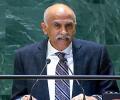
The first issue in engaging with Pakistan is the cessation of terrorism, India's envoy at the United Nations said, underlining that India has been a long-standing victim of cross-border and global terrorism and has zero tolerance towards the scourge.

A Bharatiya Janata Party-led government will not implement the nuclear deal with the United States if the Obama administration withdraws tax incentives to companies outsourcing works, a senior party functionary said on Wednesday.
Experts, scientists and economists could be invited to gather their views on the nuclear deal, CPI National Secretary D Raja said in Puducherry on Monday.
The administration is leaving no stone unturned as it races against time to have the US-India civilian nuclear agreement completed by the Congressional adjournment date of September 26 even if indications are there that the lawmakers may return for a Lame-Duck Session after the November 4 presidential elections.

The landmark civil nuclear deal sealed on Friday with Japan is strikingly similar to the agreements India has with the US and some other countries but contains some added features on safety and security, reflecting Japan's concerns on the issue.
He said there is a need to pave the way for India to benefit from nuclear power without restrictions.
Mulford said very little about the meeting except that it was regarding the civil nuclear deal during which he explained his country's position to Sinha, a key person in the BJP.
Sources in the United Progressive Alliance said the offer for a discussion was made afresh during Monday's UPA-Left committee meeting.
A recent opinion poll has shown that a majority of Americans are opposed to the landmark Indo-US civil nuclear deal at a time when the Bush administration is trying to push legislation to facilitate the smooth implementation of the accord.
India was on Wednesday unperturbed by Nuclear Suppliers Group's decision to strengthen guidelines on enrichment and reprocessing technology transfer, saying it expected its bilateral agreements on full implementation of nuclear deals to be fully honoured without any pre-conditions.
The US has categorically told Pakistan that it would not get any atomic power plant or civilian nuclear deal on the lines of the one signed with India.
US President George W Bush on Monday spoke to Prime Minister Manmohan Singh and discussed the status of the civil nuclear deal and the recent nuclear test by North Korea.
The prime minister made it clear that no constraint had been placed on India's right to construct new facilities for strategic purposes.
In an apparent reference to the Left parties' opposition to the Indo-US nuclear deal, National Security Adviser M K Narayanan on Wednesday said the lack of consensus on the issue was hampering efforts to become a part of nuclear mainstream and needed an early resolution. He said opposition to the nuclear deal within the country is driven by 'considerations' other than the factors like non-proliferation cited by some members of the international community.
Maintaining that both India and the US are seriously trying to sort out the 'outstanding issues', he, however, refused to specify when the agreement will be firmed up.
The Left and the BJP are opposed to the deal.
